Osaka
Osaka, Japan, scores 73 on the CIRA Index of tourism resilience, #28 of 309 destinations. 28 of 29 measures come from public sources, with 80% confidence. Every grade below states its value, period and source.
Scores by each organisation's criteria
- CIRA Index: 73
- OECD: 73
- UN Tourism: 80
- UNDRR: 73
Strongest
- Wastewater safely treated: 100 % of domestic wastewater safely treated (Osaka Prefectural Government, Sewerage Statistics (令和6年度末 大阪府下水道統計), FY2024). At or above 95: grade 4/4.
- Municipal waste per resident: 348.2 kg per resident per year (Ministry of the Environment of Japan, Survey on Municipal Solid Waste Disposal (一般廃棄物処理実態調査結果 令和6年度), FY2024). At or below 350: grade 4/4.
- Rent growth: 3 % change in rents over the last 12 months (Savills Japan, 'Osaka Residential Markets' / 'Residential Leasing' Report, 2024). At or below 3: grade 4/4.
Weakest
- Average length of stay: 1.4 nights per visitor (country figure) (Japan Tourism Agency, Overnight Travel Statistics Survey (宿泊旅行統計調査 2024年・年間値), 2024). Below 1.8: grade 0/4.
- Tropical nights: 106 nights a year with a minimum at or above 20°C (last 5 full years) (ERA5 reanalysis via Open-Meteo, 2021–2025). Above 100: grade 0/4.
- Flood hazard: high (region figure) (World Bank GFDRR ThinkHazard, current (retrieved 2026)). Grade 1/4.
Japan in the World Economic Forum Travel & Tourism Development Index
Japan is #1 of 110 countries (5.27 of 7) in the WEF Travel & Tourism Development Index 2026, which scores countries, not cities. Cities in countries with that WEF score average 70 on the CIRA Index; Osaka is 3 above that.
Every measure, by theme
Demand and seasonality: 75
- Nights in the three busiest months: 26.6 % of annual nights (region figure) (Japan Tourism Agency (MLIT), Overnight Travel Statistics Survey (宿泊旅行統計調査), 2024). At or below 30: grade 4/4. Source
- Domestic share of nights: 55.1 % of nights by residents of the same country (region figure) (Japan Tourism Agency (MLIT) / Osaka City Tourism Strategy Baseline Materials, Overnight Travel Statistics Survey (宿泊旅行統計調査), 2024). At or above 45: grade 4/4. Source
- Largest foreign market: 25.3 % of international arrivals or nights (region figure) (Kinki District Transport Bureau (MLIT), 2024 (Reiwa 6) Accommodation Travel Statistics Confirmed Report, 2024). Between 20 and 30: grade 2/4. Source
- Recovery against 2019: 118.2 % of 2019 visitor nights reached in the latest full year (region figure) (Japan Tourism Agency, Overnight Travel Statistics Survey (宿泊旅行統計調査) / Osaka Prefectural Government Tourism Statistics, 2024). At or above 110: grade 4/4. Source
- Average length of stay: 1.4 nights per visitor (country figure) (Japan Tourism Agency, Overnight Travel Statistics Survey (宿泊旅行統計調査 2024年・年間値), 2024). Below 1.8: grade 0/4. Source
- Hotel bed or room occupancy: 75.4 % average annual occupancy (region figure) (Japan Tourism Agency (MLIT), Overnight Travel Statistics Survey (2024 Annual Confirmed Data), 2024). At or above 75: grade 4/4. Source
Economy and jobs: 81
- Jobs in tourism industries: 4.1 % of employment in accommodation and food services (country figure) (World Economic Forum, TTDI 2026 (data: Travel & Tourism Economic Impact Research by World Travel & Tourism Council; Travel & Tourism by World Travel & Tourism Council), 2026). At or below 8: grade 4/4. Source
- Unemployment rate: 4.4 % of the labour force (region figure) (Osaka Prefectural Government, Employment Status in Osaka / Statistics Bureau of Japan, 2024). At or below 5: grade 4/4. Source
- Income per head: 45,505 GDP per capita, USD PPP (region figure) (OECD Regional Statistics / Cabinet Office Japan, 2021). Between 45,000 and 60,000: grade 3/4. Source
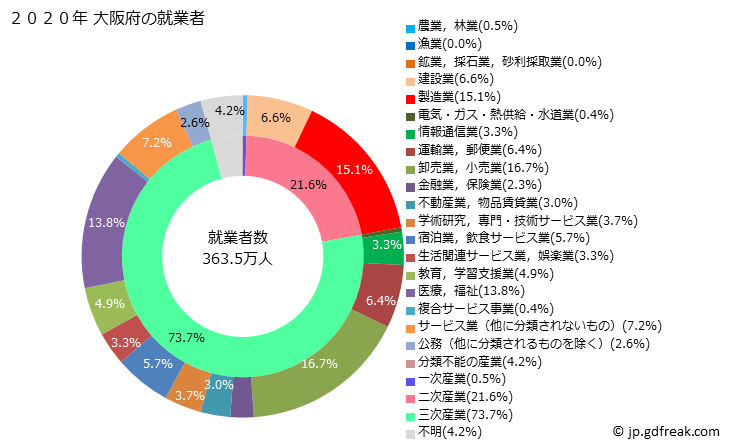
- Economic diversity: 68.2 % of employment outside accommodation, food, retail and transport (region figure) (Statistics Bureau of Japan, 2020 Population Census (reported via GD Freak! / Osaka Prefecture Industry Statistics), 2020). Between 64 and 72: grade 2/4. Source
Climate and hazards: 45
- Extreme heat days: 15.8 days a year at or above 35°C (last 5 full years) (ERA5 reanalysis via Open-Meteo, 2021–2025). Between 15 and 30: grade 2/4. Source
- Tropical nights: 106 nights a year with a minimum at or above 20°C (last 5 full years) (ERA5 reanalysis via Open-Meteo, 2021–2025). Above 100: grade 0/4. Source
- Flood hazard: high (region figure) (World Bank GFDRR ThinkHazard, current (retrieved 2026)). Grade 1/4. Source
- Wildfire and storm hazard: medium (region figure) (World Bank GFDRR ThinkHazard, current (retrieved 2026)). Grade 2/4. Source
- Country disaster risk: 2 INFORM Risk index, 0–10 (country figure) (INFORM Risk (European Commission JRC), INFORM Risk Mid 2026, 2026). At or below 2: grade 4/4. Source
Water and environment: 75
- Water scarcity: low (region figure) (World Bank GFDRR ThinkHazard, current (retrieved 2026)). Grade 3/4. Source
- Wastewater safely treated: 100 % of domestic wastewater safely treated (Osaka Prefectural Government, Sewerage Statistics (令和6年度末 大阪府下水道統計), FY2024). At or above 95: grade 4/4. Source
- Municipal waste per resident: 348.2 kg per resident per year (Ministry of the Environment of Japan, Survey on Municipal Solid Waste Disposal (一般廃棄物処理実態調査結果 令和6年度), FY2024). At or below 350: grade 4/4. Source
- Green space: 10.4 % of the urban area that is green or tree-covered (Osaka City Environment Bureau, Osaka City Environmental White Paper (大阪市環境白書), 2024). Between 10 and 20: grade 1/4. Source
Community and housing: 83
- Tourism intensity: 6.4 visitor nights per resident per year (region figure) (Japan Tourism Agency (Overnight Travel Statistics Survey 2024) & Osaka Prefectural Government Statistics Division, 2024). Between 5 and 10: grade 3/4. Source
- Cruise pressure: not measured yet
- Rent growth: 3 % change in rents over the last 12 months (Savills Japan, 'Osaka Residential Markets' / 'Residential Leasing' Report, 2024). At or below 3: grade 4/4. Source
- Short-let density: 0.8 short-term rental listings per 100 dwellings (AirDNA & Statistics Bureau of Japan (2023 Housing and Land Survey), 2023–2026). Between 0.5 and 1: grade 3/4. Source
- Resident support for tourism: not measured yet
Access and continuity: 92
- Access redundancy: 4 independent ways in: international airport, intercity rail, port, motorway (City of Osaka and Port & Airport Authorities, 2026). At or above 4: grade 4/4. Source
- Air traffic recovery: not measured yet
- Rail share of intercity access: not measured yet
- Rail traffic recovery: not measured yet
- Largest airline group share: not measured yet
- Air route concentration: not measured yet
- Early warning and emergency plan: An updated, tested plan that names visitors and tourism operators, with warnings in several languages (City of Osaka, Preparing for Accidents and Emergencies, 2025-2026). Grade 4/4. Source
- Tourism crisis and recovery plan: A plan with named owners, operators and recovery funding (Ministry of the Environment Adaptation Database (Osaka Prefecture Planning and Tourism Bureau), 2021-2025). Grade 3/4. Source
- Government effectiveness: 99.5 World Bank WGI percentile rank, 0–100 (country figure) (World Bank Worldwide Governance Indicators, 2025). At or above 80: grade 4/4. Source
- Travel advisory: 1 stricter of the US and Canadian government advisory for the country, 1 (normal precautions) to 4 (do not travel) (country figure) (US State Department and Government of Canada travel advisories, 2026-09-29). At or below 1: grade 4/4. Source
- Dedicated tourism funding: A dedicated source partly ring-fenced for residents, infrastructure or sustainability (Osaka Prefectural Government / Travel Voice, 2025-2026). Grade 3/4. Source

Compare Osaka
- Osaka vs Tokyo
- Kyoto vs Osaka
- Fukuoka vs Osaka
- Kobe vs Osaka
- Osaka vs Yokohama
- Nagoya vs Osaka
- Osaka vs Sapporo
- Osaka vs Seoul
- Osaka vs Shanghai
- Daegu vs Osaka
The CIRA Index ranking · City vs city · How the index works · CIRA Studio · Put your city in the pilot